
Asteroids And Earth — Are We In Danger? How Close And When?

NASA is always tracking asteroids and how they interact with the rest of the solar system, but how close are they to Earth? Is the planet in any danger, and if so, how dangerous might it be? NASA has a simulated webpage that showcases the behavior of our system, including satellites and the planets around us.
Asteroids In March 2026
A relatively large asteroid passed by the Earth within the past week. According to Newsweek, NASA was monitoring a bus-sized asteroid measuring around 40 feet in diameter. As it sped past our planet, it was traveling at more than 21,500 miles per hour. The space agency’s Center for Near Earth Object Studies (CNEOS) predicted it would be nearest the Earth on Thursday night. This rather large rocky body was within 198,000 miles of the planet, closer than the moon, the average distance being approximately 239,000 miles according to NASA’s Jet Propulsion Laboratory.
This asteroid, which has been labeled 2026 EG1, was said to pass beneath Antarctica, according to CT Insider. They describe it as the size of a humpback whale or school bus. They revealed it was never slated to come close to impacting Earth, with it shooting past us back into space. Some outlets said it later passed near the moon, but NASA has not confirmed the timing or distance.
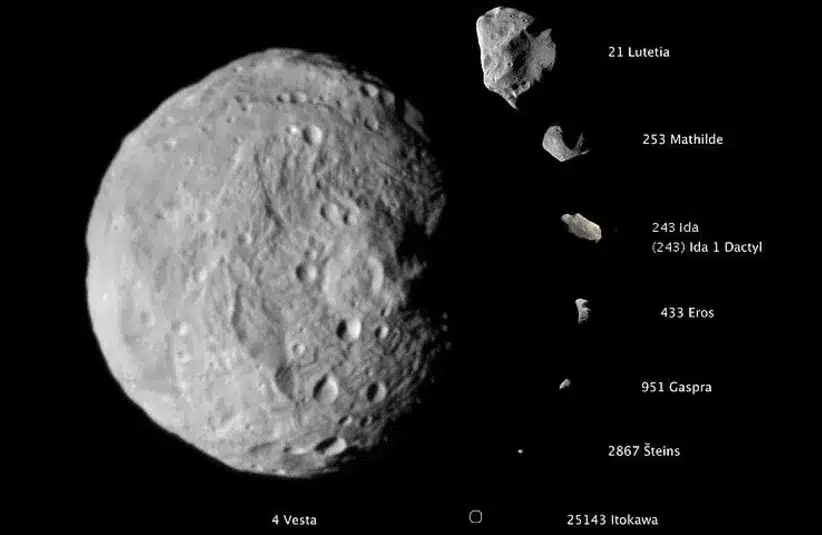
CNEOS stated that 2026 EG1 follows an oval orbit around the sun, bringing it near Earth before sending it back out into the system. Asteroids are rocky masses, remnants from when the solar system formed about 4.6 billion years ago. These formations are mostly in the main asteroid belt, surrounding the sun and floating between Mars and Jupiter.
Are There Any Coming Soon?
NASA’s JPL is constantly keeping an eye on Near-Earth objects that come close to the planet, having an asteroid watch as well as a list of upcoming large rocky masses with relative closeness. On March 16, 2026, another asteroid — 2026 ET2 — passed Earth, coming near Earth, though at a further distance than 2026 EG1. Described as 25 feet wide or the size of a large bus, it passed at a safe distance of 495,000 miles at nearly 11,000 miles per hour.
2026 EY2 was listed as coming within 986,000 miles of our planet a few hours after 2026 ET2, measured at between 23-50 feet, or about the size of a small bus or home. Based on observations, it was traveling at approximately 23,000 miles per hour, over twice as fast as 2026 ET2.
Another, named 2026 CR3, was tracked by NASA, measuring somewhere around 230 feet, nearly plane-sized. It passed by the Earth on March 16 as well, estimated at 4.64 million miles from the planet.
March 17, 2026, is expected to see an older solid object, discovered in 2015, named 2015 VO142. This one is smaller, at 20 feet in diameter. Its orbital path crosses Earth’s, which was how it was initially discovered. It will come within 649,000 miles of the planet and is described as car-sized by the asteroid watch.
On the same day, 2026 EZ2, a larger mass, is expected to pass at a safe distance of 2,340,000 miles away. This asteroid is listed as airplane-sized, being around 160 feet.
What It Means For Us
While we inhabit our planet, we will always be on the lookout for potential dangers regarding everything in space. Thanks to advances in technology, there is an international network of observatories with thousands of astronomers watching. Some key active programs that keep their eyes on the skies are
- Catalina Sky Survey — located in Arizona
- Discovers many NEA (Near Earth Asteroids)
- Pan-STARRS — located in Hawaii
- Widespread continuous coverage
- ATLAS – Telescopes in Hawaii, Chile and South
- Full-sky and rapid alert for last-second detection of close-approaching asteroids
- Vera C. Rubin Observatory — located in Chile
- New facility, expected to increase discovered NEAs
Keep your eyes on reporting from NASA and the Minor Planet Center for upcoming asteroid information.
