
Getting Strait to the Point: Iran’s Enhanced Command and Operational Expansion
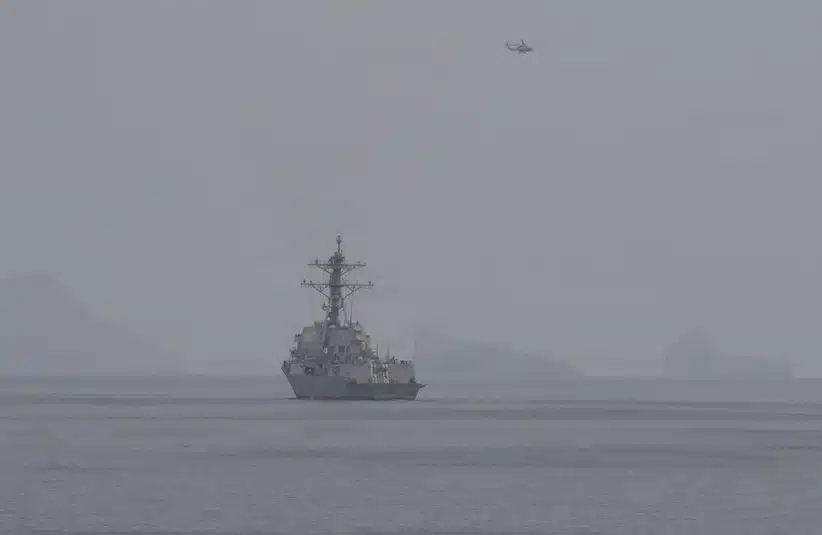
Iranian officials refused the removal of the highly enriched uranium; it seems the United States and Israel may be looking at a new avenue to handle the Islamic Revolutionary Guard Corps (IRGC). All sides of the conflict want to see an end to the war, but there are conditions both sides refuse to agree on, including Iranian sovereignty over the Strait of Hormuz and their right to nuclear arms. The IRGC and the Persian Gulf Strait Authority have seen vessels transit the strait using the new Vessel Information Declaration, creating a new level of hostility on the waterway for ships from countries that either sanction Iran or do not acknowledge the Persian Gulf Strait Authority.
Amid the diplomatic standstill, President Donald Trump went to Beijing to meet with Xi Jinping, seeking to strengthen ties and discuss conflicts affecting trade and the rising costs of the ongoing war. There were reports from Kuwait that a paramilitary group had infiltrated Bubiya Island, where China is assisting in port construction. Such skirmishes could collapse the ceasefire negotiations.
Missed Coverage: Military Preparations and Aid on the Strait of Hormuz
Based on reporting from the Institute for the Study of War (ISW), some key events were missing from previous reporting closing out May 12, 2026. The report cited an article from the Alma Research and Education Center stating that the Iranian military will conduct drills at Mahshahr Port, which hosts the IRGC Navy 3rd Imam Hossein Region base. Furthermore, based on developments from IribNews recorded by the ISW, the IRGC Mohammad Rasoul Ollah Unit was running drills in Tehran Province. The unit commander, Brigadier General Hassan Hassanzadeh, was noted to have said these drills were to ensure military preparedness for enemy activity from the United States and Israel.
The United Kingdom joined Lithuania’s contribution of 40 provisional soldiers and personnel to aid the mission of mine-clearing in the Strait of Hormuz. May 12, during a virtual summit, British Defense Minister John Healey announced the UK would contribute autonomous mine-hunting equipment, the destroyer HMS Dragon, and Typhoon fighter jets. Australian Defense Minister Richard Marles added support to the UK and French-led mission to secure passage across the Strait, contributing an E-7A Wedgetail surveillance aircraft on May 13, 2026. The ISW noted the allies say it will happen once conditions are clear and they have an understanding of the United States operational needs.
These developments were underscored by records from The Economist on May 12, 2026, showing Saudi oil exports cut by roughly one-third, the United Arab Emirates (UAE) dropping by approximately half, with Bahrain, Qatar, and Kuwait exporting nearly none.
Expansion: Iranian Control Over the Strait
The United States Central Command (CENTCOM) was cited by the ISW, announcing that naval forces redirected 70 Iranian ships, disabling 4 others as of May 13, 2026. IRGC Navy Political Deputy Brigadier General Mohammad Akbarzadeh proclaimed the operational area in the Strait expanded beyond Hormuz and Hengam islands, turning the 20-30 mile span into a 200-300 mile crescent. It now stretches from Jask and Sirik to beyond the Qeshm Island and Greater Tunb. The ISW notes a statement made by Supreme Leader adviser Mohammad Mokhber from May 8, 2026, where the Strait has become of comparable value to nuclear weapons, which may be why the expansion has gone so far.
According to Reuters, follow-up ISW analysis on May 13 indicated that Iran successfully leveraged its regional diplomacy to secure transit-compliance agreements that exempt Iraq and Pakistan from shipping tolls on crude oil and liquefied natural gas (LNG), Reuters did not identify the sources of this information. In a separate development, United States officials reported that Chinese companies have been negotiating with Tehran to transit illicit arms shipments to Iran through the use of African transit countries. Meanwhile, Gulf states have reportedly expanded land-based trade and logistics across the Arabian Peninsula to curb reliance on the waterway, according to the Wall Street Journal on May 12. This includes ground routes through Saudi Arabia, the UAE, and Oman.
Artesh Spokesperson Brigadier General Mohammad Akraminia was on record by MehrNews, reported through the ISW, to have said Iran plans to cease United States weapons from passing the waterway to regional bases. This could affect UK naval facilities in Bahrain and French naval facilities in the UAE if Iran sees them as threats to its interests, according to ISW analysis of the situation. Akraminia further insisted that the goals of destroying Iran’s weapons and nuclear facilities, in an effort to fragment the country and topple the system, failed. Instead of breaking Iran, Iran has enhanced its command of the Strait, exceeding the financial yield from normal Strait operations, per the MehrNews article the ISW cited.
Hezbollah and Israel Defense Forces: First Person View Drone Manufacturing
Due to Hezbollah’s ability to strike the Israel Defense Forces (IDF) with first-person view (FPV) drones, an Israeli military correspondent reported on May 12, 2026, that the IDF is developing domestic FPV drone and component production to eliminate reliance on Chinese manufacturers. This will function as their offensive response, while the correspondent also added that they will deploy rotating barbed-wire fencing to sever drone cables. The new countermeasure will be used in conjunction with hunting shotguns for targeting FPV drones from Hezbollah, previously reported by the ISW to be in use by soldiers to target Hezbollah drones.
Hezbollah demonstrated its tactical evolution by launching the most complex FPV drone strike to date on May 12, 2026, utilizing a swarm of at least five drones in a two-wave attack on an IDF site near Margaliot. Israeli media reports covered by the ISW confirmed that two drones from the first wave ignited a fire, and the larger second wave circled for several minutes before striking. Although Hezbollah claimed to have successfully struck counter-drone electronic equipment, this proved that the decentralized operator network does not inhibit the ability to execute coordinated multi-drone operations.
The successful strike showed that IDF countermeasures failed to intercept the drones or prevent Hezbollah from conducting battlefield reconnaissance. The IDF has executed previous orders to expand the geographic scope of its air operations beyond southern Lebanon, specifically targeting Hezbollah’s drone supply chain and production infrastructure.
Looking On: Seizures Upon The Strait
Reports from the Associated Press (AP), authorities said on May 14, 2026, a ship anchored off the UAE was seized and taken towards Iran, while another cargo ship near Oman sank after being attacked. The incidents happened shortly after a senior Iranian official reiterated Iran’s claim over the Strait and another claimed the right to seize oil tankers connected to the United States. The Strait has continued to be a major point amid talks between the United States and Iran to end the fight. The White House said after President Donald Trump met with Xi Jinping, both agreed that the Strait of Hormuz must remain open.
According to the United Kingdom Maritime Trade Operations center, reports indicate that the ship taken on May 14, 2026, was seized by unauthorized personnel while anchored 38 nautical miles northeast of the UAE port Fujiarah. AP notes that the export terminal has been repeatedly attacked during the ongoing war with Iran. The maritime center did not name the seized vessel, but the British military is investigating as it heads toward Iranian waters.
Indian authorities said an Indian-flagged vessel sank off the coast of Oman, having sustained an attack that ignited a fire while transiting from Somalia to Sharjah, another UAE port. It is unclear who attacked, but Mukesh Mangal of India’s shipping ministry said the Indian-flagged cargo ship Haji Ali was attacked on May 13, 2026. Oman’s coast guard rescued the 14 crew members, and they are safe. India’s foreign ministry condemned the continued attacks on maritime freight and civilian ships, calling the incident unacceptable.
The seizure of the ship off the coast of the UAE came hours after Prime Minister Benjamin Netanyahu said he visited the country, though the UAE denies it. The two have had established relations since the Abraham Accords in 2020, something Iran has heavily criticized, according to AP reporting.
New Talks: The Same Demands
Iran stands firm in refusing talks with the United States unless Iran’s five demands are met. Iran’s semiofficial Fars News agency cited an informed source in the report that AP analyzed, saying they want reparations for the war, and acceptance of Iran’s sovereignty over the Strait of Hormuz. As the United States’ track record has already shown, it is unlikely the demands will be accepted. A broadcast on the Islamic Republic of Iran Broadcasting (IRIB), the official state TV, had Iran’s senior vice president, Mohammadreza Aref, on May 14, 2026, saying the Strait belongs to Iran and has always belonged to Tehran. They will not give the waterway up at any price.
AP reported that Iran’s judiciary spokesperson told the state-owned Iran Daily on May 14, 2026, that Iran believes it has the legal and judicial authority to seize United States-linked tankers in the Strait. He argued that the United States violated international maritime laws and engaged in acts that Iran considers piracy. The spokesperson, Asghar Jahngir, did not directly mention the tanker taken the same day.
However, Admiral Brad Cooper told lawmakers in Congress he believes Iran’s military might has been degraded, and the rhetoric by its leaders is what is impacting the Strait.
