
5 Astounding Things About Lightning Happening In Our Atmosphere
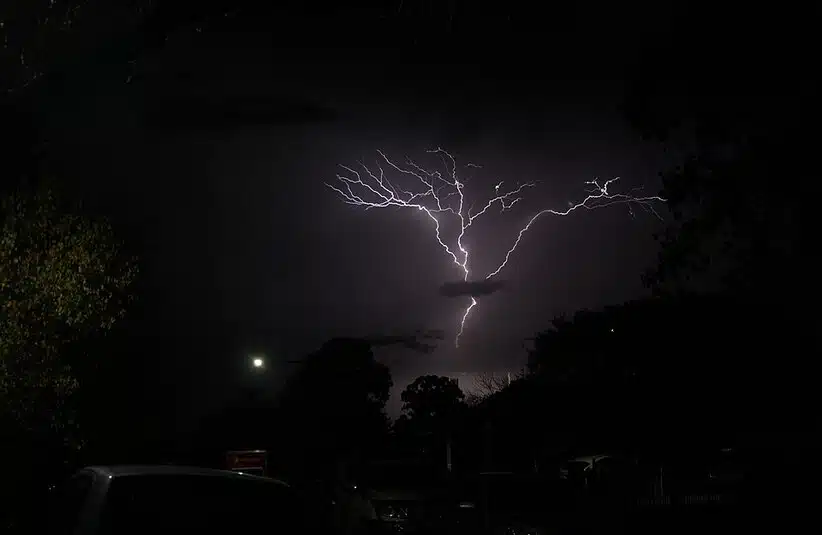
Research into atmospheric changes happening around us suggests there might be something shocking regarding lightning and thunderstorms happening in the forests. Research published in Feb. 2026 indicates that there are ultraviolet sparkles occurring during thunderstorms. For the first time, researchers managed to capture this on film, stirring curiosity as to what they were observing.
Treetops Glow and Sparkle
While we all know thunderstorms are accompanied by varying bright flashes of lightning, it would appear the treetops are also having their own spectacular lightshow. While the Smithsonian Magazine says they’re invisible to the human eye unaided, they were captured with a special camera that can detect ultraviolet emissions. This was able to show coronae, or a weak electrical discharge that looks like a faint blue glow or sparkle on the tips of leaves and needles.
A Lightshow No One Could See
Researchers and scientists have long theorized that treetops could produce electrical outbursts while thunderstorms occur due to electrical field anomalies that happen in forests. As thunderstorms build up clouds with negative electricity, the ground develops a positive charge. This results in the positive charge traveling to the tallest point toward the clouds and the treetops, and upon reaching the tips of the leaves, an electric field begins to surround the air.
A meteorologist from Pennsylvania State University, Patrick McFarland, got his colleagues together and came up with an ingenious plan. They turned a 2013 Toyota Sienna into an electric field detector, complete with a laser rangefinder for measuring distances, and an elevated periscope transmitting UV light to a camera. Through this altered Toyota van, they captured hundreds of signals. McFarland likened the phenomenon to thousands of fireflies dancing among the treetops.
Evolution Within The Trees
While science has found a dazzling light show, this discovery produced curiosity as to how trees can keep themselves safe. The Smithsonian reported that through a series of experiments in a laboratory setting, these electrical discharges caused leaves to burn within seconds. If the leaves were being harmed by the experiments, could that lead to sun damage and tree dehydration? With how frequently thunderstorms happen in forested regions, researchers have posited that trees may have evolved in order to protect themselves.
Clearing Up The Air
Based on McFarland’s research, the UV from the electrical charge breaks down water vapor and produces hydroxyl. This happens to be the atmosphere’s primary oxidizer that cleans air by reacting with chemicals emitted into the air. This means that the corona effect is essentially removing other chemicals like a filter, all happening in the forest. Included are volatile organic compounds (VOCs) released by natural and human activities, as well as methane, a potent greenhouse gas.
This conversion is what researchers focused on by doing controlled experiments with high-voltage, low-current electric impulses. They found a connection between the UV emissions and the creation of hydroxyl, which, in conjunction with recent research, showed damage where the coronae were emitted. The researchers sought to capture the event and use the connection. They created the Corona Observing Telescope System (COTS), a specialized telescope attachment blocking direct blinding light, to observe the corona.
Mysteries Surrounding Lightning
People have been amazed and mystified by lightning ever since Benjamin Franklin’s experiments centuries ago, but theories have never managed to capture how it begins. Professor Dr. Victor Pasko, an electrical engineering professor at Penn State, has studied lightning formation for more than two decades, according to Herald Insight reporting. Along with a doctoral researcher, Zaid Pervez, they aligned a model with laboratory experiments alongside real-world data to confirm the process behind lightning initiation.
Through the research study, data confirmed a chain reaction that creates conductive channels in the air, which becomes the lightning bolt seen in the skies. Measurements of atmospheric conditions and activity inside thunderclouds confirmed the presence of runaway electrons, matching predictions from simulations and laboratory experiments. The study results showed a trigger occurring when cosmic rays from space come in contact with Earth’s atmosphere, producing a shower of secondary particles that enter thundercloud’s electric field.
